Looking for an orchestra in Bangladesh? Orchestral music here is small but growing. This guide traces where Bangladeshi orchestras come from, who plays in them today, and how to hear or hire one. It is written by Shariful Islam, a Dhaka-based violinist and conductor and founder of the Dhaka Symphony Orchestra, who has worked inside much of this history since 2010.
Bengal’s music before the orchestra
Bengal’s own music — raga-based classical music, Baul and Sufi song, kirtan, and folk forms such as bhatiali and bhawaiya — developed without the Western orchestra. European instruments arrived during the colonial period, above all the violin, which Bengali musicians adopted and played in their own way. Film, radio and television later created work for string and wind players, but these were studio ensembles rather than concert orchestras.
After independence: the Dhaka Orchestra (1972)
Soon after independence in 1971, an ensemble called the Dhaka Orchestra was formed in 1972. Today no recordings or written documents of it can be found, and it is not even clear who played in it. At some point the orchestra disappeared. How and why it ended, and what became of its musicians, remains unknown — a gap in Bangladesh’s music history that urgently needs research.
In the decades that followed there were scattered attempts to form orchestras, but they were so isolated that almost nothing was documented. Throughout this period the steadiest home for orchestral players was the armed forces: the orchestras of the Bangladesh Army, Navy and Air Force.
2010: a new beginning — the Classical Music Academy
In 2010 Shariful Islam met the guitarist Iftekhar Anwar, who had returned from a master’s degree in classical guitar at Arizona State University and was teaching guitar at Alliance Française de Dhaka. He wanted to build an ensemble that needed violinists, and the two began rehearsing together at Alliance Française.
It soon became clear that an orchestra would need many violinists — and that they would have to be trained from scratch. Encouraged by Iftekhar Anwar, Shariful turned to teaching violin, first at Marie Curie School. Together they founded the Classical Music Academy (CMA), headed by Iftekhar Anwar.
CMA went from school to school handing out leaflets and launched programmes at three schools, including St. Joseph and Green Herald. Violin was taught by Shariful Islam and Sydney Rodrigues, an English teacher at St. Joseph and an accomplished violinist; Iftekhar Anwar taught guitar.
First stage: Rahom Alir Putul Nach
Within about a year the students gave their first major performance, Rahom Alir Putul Nach, at Bishwo Shahitto Kendro. The concept and music were by Iftekhar Anwar; Shariful Islam prepared and led the string section — close to conducting, though not yet called that. Most of the players were science students who were completely new to their instruments.
2012–13: Swedish musicians and a first attempt at a national orchestra
Around 2012–13 three Swedish musicians came to Dhaka: violinist Eva Linda, flautist Max Möller and his son, guitarist Johannes Möller. With the support of Sunny Zubair, a series of meetings began with Bangladesh Shilpakala Academy about forming a national orchestra. Shilpakala hosted a workshop in which the three Swedish musicians coached local players, ending in a performance. The initiative did not go further, and Shariful Islam, Iftekhar Anwar and Sydney Rodrigues returned to their school programmes and to CMA.
The CMA orchestra and a solo path (2013–2019)
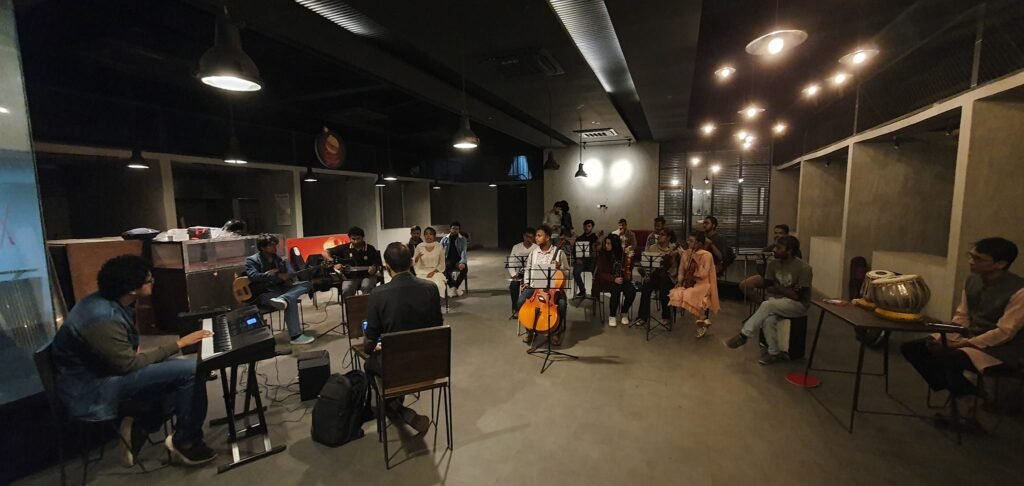
CMA eventually formed its own orchestra — a beginner-level ensemble, but one that gave a number of performances. Alongside the string players it brought in other instruments: Mitul and Joy on classical guitar, and Mahadi, who first played flute and later switched to clarinet when Akash joined on flute and vocals. The rest of the ensemble were CMA’s own students. In 2017 Shariful left CMA to focus on a solo career, playing regularly at a hotel in Dhaka, and in 2018 joined the Korean-run Dhaka International Music School as violin teacher.
Professional orchestras: Navy and Army (2020–2025)
When COVID-19 brought everything to a halt in 2020, Shariful joined the Bangladesh Navy Orchestra. Until then he had worked with amateur string players — students learning violin alongside their studies, who came when they could. For the first time he was working with a professional, salaried ensemble of about 23 musicians.
He first brought the group through the beginner stage. As the International Fleet Review (IFR) approached, he began arranging music for the orchestra and conducting it. The IFR — one of the Navy’s largest events — was held in Cox’s Bazar in December 2022, with the orchestra performing under his direction. His Navy contract ended in January 2023.
In June 2023 he joined the Bangladesh Army Orchestra, which wanted a string section to complete its brass and woodwind players; the band had traditionally played the same melody in unison rather than in true orchestral parts. He worked with the Army Orchestra for nearly two years, until his contract ended in February 2025. In January 2026 he rejoined the Bangladesh Navy Orchestra, where he works today.
An orchestra for everyone: the Dhaka Symphony Orchestra (2022–)
Alongside his Navy work, Shariful began working with Clef Foundation’s music academy at its invitation. A question kept coming up: how can a country have Army, Navy and Air Force orchestras, but no orchestra for ordinary citizens? Starting with the academy’s students, they began building one — the Dhaka Symphony Orchestra.
In 2022 the band Shironamhin, marking its 25th anniversary, wanted to perform with an orchestra. The joint concert of Shironamhin and the Dhaka Symphony Orchestra was a success, and the orchestra has worked steadily since. It is now independent of Clef Foundation and runs as its own organisation, with Shariful Islam leading it professionally alongside his Navy work.
Orchestras and ensembles in Bangladesh today
- Military orchestras — the Bangladesh Army Orchestra, Bangladesh Navy Orchestra and Bangladesh Air Force orchestra, which perform mainly at official and ceremonial occasions.
- Independent orchestras — including the Dhaka Symphony Orchestra, which performs concerts and commissions new Bangladeshi orchestral music.
- Cultural institutions — Bangladesh Shilpakala Academy hosts classical concerts and events.
- Studio and event ensembles — string groups assembled for film, television, recordings, weddings and corporate events.
What makes a Bangladeshi orchestra different
A Bangladeshi orchestra does not need to copy a European one. Its players often grow up with both notation and ear-based learning, and with melodies full of ornaments and slides that Western scores rarely write down. The most interesting new work puts those skills to use: orchestral arrangements of Lalon and other Baul songs, pieces built on folk rhythms, and new compositions that mix orchestral colour with field recordings and improvisation.
Challenges
- Training — there are few places to study orchestral instruments to a professional level; most players still start from zero, as the history above shows.
- Instruments — violins, violas and cellos are mostly imported and struggle in Bangladesh’s heat and humidity, and there are almost no local instrument makers.
- Documentation — from the 1972 Dhaka Orchestra onwards, too little has been recorded or archived.
- Funding and venues — orchestras need steady support and halls with good acoustics.
Building a full orchestra ecosystem — local instrument making, training, and a permanent symphony orchestra — is the long-term work Shariful Islam and the Dhaka Symphony Orchestra are committed to.
How to hear or hire an orchestra in Bangladesh
- Concerts — follow the Dhaka Symphony Orchestra and Bangladesh Shilpakala Academy for announcements.
- Events — string quartets and small orchestras can be booked for weddings, receptions, launches and ceremonies.
- Commissions — orchestral arrangements, film scores and new works.
To book the Dhaka Symphony Orchestra or a smaller ensemble, contact Shariful Islam. For violin lessons in Dhaka, see Lessons.
বাংলাদেশের অর্কেস্ট্রা
স্বাধীনতার পর ১৯৭২ সালে “ঢাকা অর্কেস্ট্রা” গড়ে উঠলেও তার কোনো রেকর্ডিং বা দলিল আজ পাওয়া যায় না। দীর্ঘদিন অর্কেস্ট্রা শিল্পীদের প্রধান আশ্রয় ছিল সেনা, নৌ ও বিমান বাহিনীর অর্কেস্ট্রা। ২০১০ সাল থেকে বেহালাবাদক ও কন্ডাক্টর শরিফুল ইসলাম স্কুলে স্কুলে বেহালা শিখিয়ে এবং ক্লাসিক্যাল মিউজিক একাডেমি, নৌবাহিনী ও সেনাবাহিনী অর্কেস্ট্রার সঙ্গে কাজ করে নতুন প্রজন্মের শিল্পী তৈরি করেছেন। ২০২২ সালে তিনি গড়ে তোলেন সাধারণ মানুষের অর্কেস্ট্রা, ঢাকা সিম্ফনি অর্কেস্ট্রা। কনসার্ট, অনুষ্ঠান বা নতুন সংগীত রচনার জন্য যোগাযোগ করুন।
Frequently asked questions
Does Bangladesh have a symphony orchestra?
Yes. The Army, Navy and Air Force maintain orchestras, and the Dhaka Symphony Orchestra is an independent orchestra based in Dhaka.
Was there an orchestra in Bangladesh after independence?
Yes. The Dhaka Orchestra was formed in 1972, but no recordings or documents of it are known to survive.
Can I hire an orchestra in Dhaka?
Yes, from a string quartet to a full ensemble. Send an enquiry with your date, venue and budget.
Where can I learn violin in Bangladesh?
Shariful Islam teaches violin in Dhaka. See Lessons.